
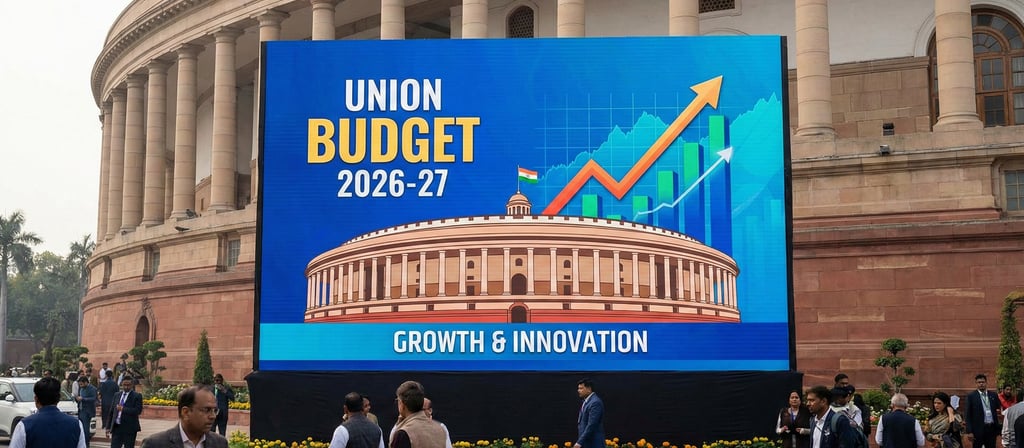
Let’s be real—February 1st is the only day of the year when tax statutes get more views than cricket scores. But while the news channels debate fiscal deficits and GDP decimals, those of us running businesses or managing compliance are asking a simpler question: Is my life going to get easier, or harder?
The buzz for Union Budget 2026-27 isn't about flashy announcements; it’s about fixing the friction points. Based on the pre-budget memorandums from chambers like FICCI and the ground reality we see with clients every day, here are the 8 things the industry is actually betting on.
1. The TDS "Cleanup" We Desperately Need
If you handle accounts or compliance, you know the pain of TDS. Currently, we are juggling nearly 37 different rates ranging from 0.1% to 30%. It’s a classification nightmare.
The Expectation: A drastic simplification. The industry wants these boiled down to just 2 or 3 standard rates.
Why it matters: Fewer rates mean fewer accidental defaults. It stops the endless back-and-forth notices from the department over whether a payment was a "fee for technical services" or a "contract."
2. Capital Gains: The "Holding Period" Headache
Right now, the definition of "Long Term" changes depending on what you bought. Is it 12 months? 24 months? 36 months? It depends on whether it's a share, a mutual fund, or a building. It's messy.
The Expectation: Harmonization. We expect a uniform holding period (likely 12 or 24 months) across most asset classes to qualify for Long Term Capital Gains (LTCG).
The V&A View: This would be a massive relief for investors and would significantly reduce the complexity of filing IT returns.
3. Mergers: Aligning Tax with Company Law
The Companies Act has made "Fast Track Mergers" relatively smooth. But the Income Tax Act hasn't quite caught up. Often, a restructuring that is simple on paper becomes a tax burden because the "tax neutrality" provisions don't align perfectly with the newer corporate law options.
The Expectation: Specific amendments to ensure that Fast Track Mergers and demergers don't trigger a surprise tax bill.
The Reality: If this goes through, expect a lot more mid-sized firms to restructure for efficiency in FY 26-27.
4. The "Middle Class" Consumption Boost
With global export markets looking a bit shaky, the government needs domestic consumption to stay strong. That means putting more money in the hands of the salaried class.
The Buzz: All eyes are on the Standard Deduction. There is a strong consensus that it needs a hike—potentially up to ₹1 Lakh—to keep pace with inflation.
The Shift: We also expect more "sweeteners" to make the New Tax Regime the default choice, possibly by allowing deductions for health insurance (Section 80D) which are currently missing there.
5. MSMEs: Credit Over Subsidies
For our MSME clients, the challenge is rarely "lack of ideas"—it's "working capital."
The Expectation: An expansion of the Credit Guarantee Scheme, specifically targeting the service sector (which often gets left out compared to manufacturing).
The Catch: The government usually pairs these benefits with stricter registration norms (like Udyam). If new credit schemes are announced, expect compliance to be the key to unlocking them.
6. Customs: The 8-to-4 Rationalization
For importers, the current customs structure with 8 different tariff slabs is a recipe for litigation. The government has hinted at reducing this to 4 slabs. This would be a massive win for "Ease of Doing Business"—a phrase we hear often, but need to see in practice.
7. IBC Reforms: Making "Exits" Easier
For a Company Secretary, winding up a company or resolving insolvency is currently a slow, painful process. The NCLT benches are overloaded.
The Expectation: We aren't just looking for more judges; we are expecting policy tweaks to the Insolvency and Bankruptcy Code (IBC) to speed up the admission of cases.
The Bottom Line: Capital only comes into India if it knows it can get out. Faster exits mean more confidence for foreign investors.
8. The "Green" Ledger
Sustainability is no longer just for PR; it's becoming a compliance mandate (hello, BRSR).
The Expectation: Expansion of the PLI (Production Linked Incentive) schemes to cover more green energy components and potential tax breaks for issuing Green Bonds.
The Opportunity: For companies that are already investing in ESG (Environmental, Social, and Governance), this Budget might finally offer some financial ROI to match the compliance effort.
The Verdict?
We aren't expecting a "revolutionary" budget that flips the economy upside down. We are expecting a "maintenance" budget—one that oils the gears and removes the rust.
Our Advice? Ignore the rumors on WhatsApp. Wait for the Finance Bill. As always, the difference between a good year and a bad year often lies in the fine print.
At Vashistha & Associates, we will be dissecting the actual notification the moment it lands. Stay tuned for our practical breakdown of how the changes impact your compliances for FY 26-27.


© 2025 Vashistha & Associates. All rights reserved.
Quick Links
Helpful Links
Office Hours
Monday – Saturday
9:00 AM – 6:00 PM IST
Sunday: Closed
Reach Out

